Introduction
Have you ever seen a cute face made of text in a message, like (^◡^) or (╯°□°)╯︵ ┻━┻? That is a kaomoji. These Japanese text emoticons show feelings that words alone cannot express, and once you learn to read them, you will spot them everywhere.
The word kaomoji means “face characters” in Japanese. Also, western emoticons like 🙂 need a head tilt to read, but Japanese emoticons face forward. This makes them far more expressive, because the face looks straight at you.
Text faces are loved by anime fans, gamers, and anyone who wants warmer messages. They work in every app and look the same on every device. In fact, this guide gives you more than 300 Japanese emoticons to copy and paste, explains what the most popular ones mean, and shows exactly when to use each one.
What Are Kaomoji?
Japanese text faces (顔文字) are a style of emoticon that started in Japan. The word breaks into “kao” (face) and “moji” (character), so a kaomoji is literally a face made of characters.
Western emoticons like 🙂 are read sideways. In fact, ASCII faces face forward, showing eyes, mouth, and even arms. This gives them a huge range, from a simple smile (^_^) to a full table flip (╯°□°)╯︵ ┻━┻.
Moreover, people use Japanese emoticons in texts, social posts, gaming chats, comments, and usernames. They add emotion without pictures and look identical everywhere, since they are plain text.
Common uses include greeting friends, showing happiness or sadness, reacting to funny messages, and making posts friendlier. They fit casual chats where tone is hard to read.
Indeed, popular examples include (^◡^) for a big happy smile, (T_T) for crying, (¬‿¬) for a knowing smirk, and ¯\_(ツ)_/¯ for a shrug. Each one carries a feeling that words would take a sentence to explain.
General Meaning
In general, Japanese emoticons show emotion through a tiny text face. In addition, they replace the facial expressions missing from typed messages. A happy text face warms a message, while a sad one shows sympathy.
Romantic Meaning
In flirty chats, ASCII faces add sweetness. Furthermore, a blushing face like (⁄ ⁄>⁄ ▽ ⁄<⁄ ⁄) says “you make me shy” without words. Couples use cute Japanese emoticons to make messages feel more affectionate.
Friendly Meaning
Specifically, among friends, text faces keep things relaxed and warm. Sending (^▽^) with a greeting feels like waving hello. Friends use them to joke around and react to stories.
Funny Meaning
Also, funny ASCII faces are perfect reactions. When a friend sends a hilarious meme, (≧◡≦) shows you are laughing hard. Dramatic ones like (╯°□°)╯︵ ┻━┻ turn frustration into comedy.
Sarcastic Meaning
In fact, some Japanese emoticons carry sarcasm. (¬‿¬) can mean “sure, I totally believe you” with a built-in eye roll. (ಠ_ಠ) is the classic look of disapproval for ridiculous statements.
Social Media Meaning
On social media, text faces help posts stand out in captions, comments, bios, and usernames. Cute ones like (✿◠‿◠) suit aesthetic posts, while funny ones land in reaction comments.
Text Message Meaning
Moreover, in texts, ASCII faces clarify tone. “Fine.” sounds angry, but “fine. (¬‿¬)” sounds playful. They prevent misunderstandings and make short messages friendlier.
Workplace Meaning
In casual work chats, a simple (^_^) can soften a message. Indeed, avoid dramatic ones at work, and only use them with coworkers you know well.
When Should You Use Kaomoji?
Japanese emoticons fit many everyday situations:
- Greeting warmly: “Hey! (^▽^)” feels friendlier than plain “Hey!”
- Showing happiness: add (≧◡≦) when sharing good news.
- Softening an apology: “Sorry about that (T_T)” feels sincere.
- Reacting to funny content: (≧∀≦) says you are laughing.
- Showing confusion: (・・ ) ? or (⊙_⊙) when things don’t make sense.
- Playful frustration: (╯°□°)╯︵ ┻━┻ turns annoyance into a joke.
- Gentle flirting: (⁄ ⁄>⁄ ▽ ⁄<⁄ ⁄) adds a sweet, nervous feeling.
- Celebrating: (ノ◕ヮ◕)ノ*:・゚✧ spreads joy for great news.
- Showing sympathy: (。•́︿•̀。) says you feel bad for them.
- Saying goodbye: “Bye bye! (^◡^)” ends on a happy note.
Texting examples:
- “Did you see the game last night?? (⊙_⊙)”
- “I finally finished my homework! (ノ◕ヮ◕)ノ*:・゚✧”
- “I dropped my phone again… (T_T)”
- “Thanks for helping me out (^▽^)”
Kaomoji for Girls
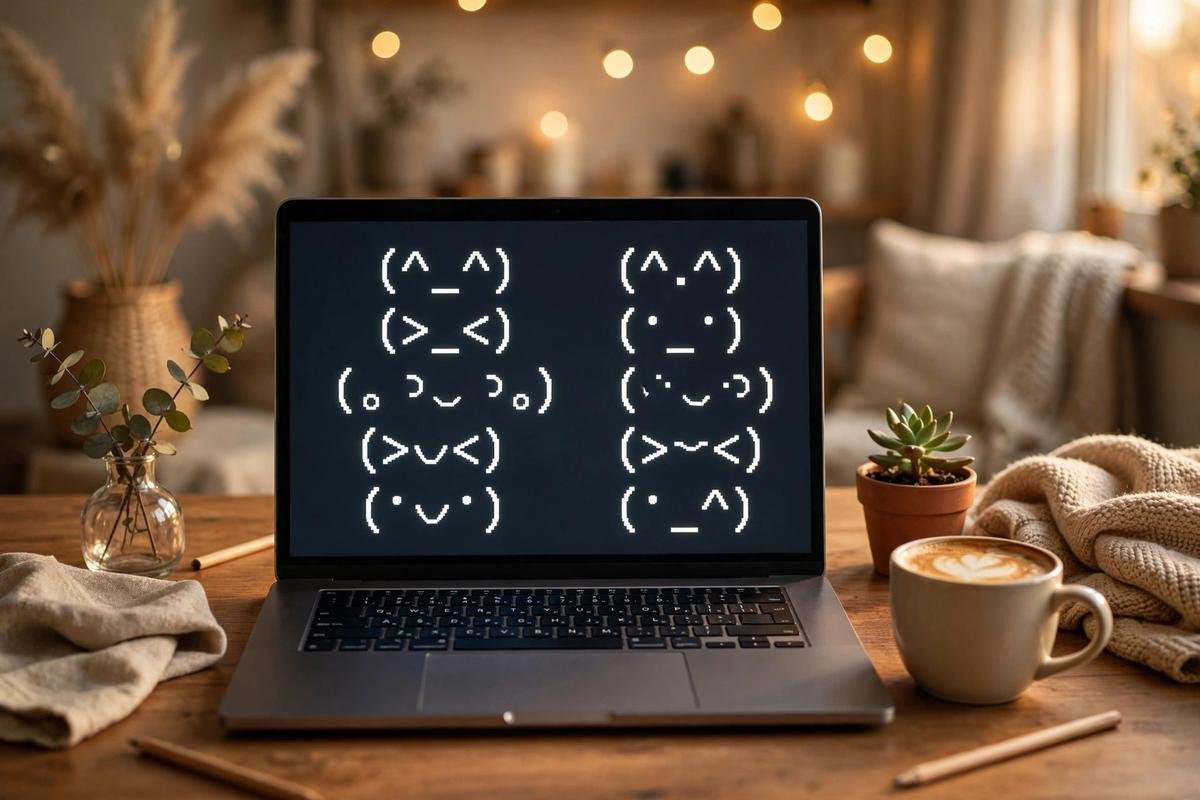
Many girls use Japanese emoticons to add cuteness to messages. Faces like (✿◠‿◠), (◕‿◕✿), and (^◡^) are favorites because they feel soft and friendly.
In addition, a girl might send (⁄ ⁄>⁄ ▽ ⁄<⁄ ⁄) when shy or flattered, and (≧◡≦) when excited. These make everyday chats feel more personal.
Examples:
- “Aww thank you!! (◕‿◕✿)”
- “He actually texted me back!! (⁄ ⁄>⁄ ▽ ⁄<⁄ ⁄)”
- “I missed you (。•́︿•̀。)”
Kaomoji for Guys
Guys often use Japanese emoticons for humor and reactions. Furthermore, the shrug ¯\_(ツ)_/¯, the table flip (╯°□°)╯︵ ┻━┻, and the deadpan (¬_¬) are classics.
A guy might send (¬‿¬) to tease a friend or (⊙_⊙) when surprised. In gaming chats, (ง’̀-‘́)ง shows fighting spirit.
Examples:
- “I have no idea what happened ¯\_(ツ)_/¯”
- “My team lost again (╯°□°)╯︵ ┻━┻”
- “Nice try bro (¬‿¬)”
Kaomoji on Snapchat
Specifically, on Snapchat, text faces appear in captions over snaps, in chat messages, and in usernames. Since snaps disappear fast, a ASCII face adds instant emotion to a short caption. Cute faces suit selfies, while (≧∀≦) pairs with silly snaps.
Kaomoji on WhatsApp
Japanese emoticons work perfectly on WhatsApp because the app handles plain text. They shine in group chats for quick reactions. Also, common uses include morning greetings with (^▽^), laughing at jokes with (≧◡≦), and sympathy with (T_T). They never render differently on anyone’s phone.
Kaomoji on Instagram
Instagram users put Japanese emoticons in captions, comments, and bios. In fact, aesthetic accounts love (✿◠‿◠) and decorative faces. In comments, a quick (^◡^) shows love on a friend’s post. Moreover, bios use small text face as decoration between lines.
Kaomoji on TikTok
TikTok comments are full of Japanese emoticons. Viewers use (≧◡≦) for videos they loved and (T_T) for emotional content. Indeed, funny videos get (╯°□°)╯︵ ┻━┻ in the comments. Creators use them in captions and on-screen text to set the mood.
Kaomoji Combinations
ASCII faces pair well with emojis, symbols, and words. In addition, here are popular combinations and what they express.
| Kaomoji Combination | Meaning |
|---|---|
| (^◡^) ✨ | Sparkling happiness, pure joy |
| (T_T) 💔 | Heartbreak, deep sadness |
| (≧◡≦) 🎉 | Celebration, party excitement |
| (╯°□°)╯︵ ┻━┻ 😤 | Playful rage, dramatic frustration |
| (¬‿¬) 😉 | Knowing smirk, playful teasing |
| (⁄ ⁄>⁄ ▽ ⁄<⁄ ⁄) 💕 | Shy crush, blushing love |
| ¯\_(ツ)_/¯ 🤷 | Total confusion, giving up |
| (⊙_⊙) 😳 | Shock, disbelief |
| (ノ◕ヮ◕)ノ*:・゚✧ 🎊 | Big celebration, confetti mood |
| (。•́︿•̀。) 🤗 | Needing comfort, feeling down |
| (✿◠‿◠) 🌸 | Cute aesthetic vibe |
| (ง’̀-‘́)ง 💪 | Ready to fight, determination |
| (^▽^) 👋 | Friendly greeting, waving hello |
| (≧∀≦) 😂 | Laughing hard, hilarious reaction |
| (¬_¬) 🙄 | Unimpressed, eye roll |
| (◕‿◕✿) 💖 | Sweet affection, cute love |
| (⋋_⋌) 😬 | Awkward, uncomfortable moment |
| (^◡^) ☀️ | Bright sunny mood |
Copy and Paste Kaomoji
Click any Japanese emoticon below to copy it. Paste it into any message, comment, or post.
Happy Kaomoji
(^◡^) Copy
(^_^) Copy
(^▽^) Copy
(≧◡≦) Copy
(◕‿◕) Copy
(✿◠‿◠) Copy
(◕‿◕✿) Copy
(^ω^) Copy
(≧∀≦) Copy
(ノ◕ヮ◕)ノ*:・゚✧ Copy
(ノ´ヮ`)ノ*: ・゚ Copy
ヽ(^▽^)ノ Copy
(☆▽☆) Copy
(*^▽^*) Copy
(^v^) Copy
٩(◕‿◕)۶ Copy
(≧▽≦) Copy
(*≧▽≦) Copy
(´∀`) Copy
(´▽`) Copy
Sad Kaomoji
(T_T) Copy
(。•́︿•̀。) Copy
(╥﹏╥) Copy
(;_;) Copy
(ಥ_ಥ) Copy
(´;ω;`) Copy
(;一_一) Copy
( T_T)\(^_^ ) Copy
(ノ_<。) Copy
。・゜・(ノД`)・゜・。Copy
Love and Cute Kaomoji
(⁄ ⁄>⁄ ▽ ⁄<⁄ ⁄) Copy
(♥‿♥) Copy
(♡˙︶˙♡) Copy
(´ε` ) Copy
(づ ̄ ³ ̄)づ Copy
(ノ´ з `)ノ Copy
(❀◦‿◦) Copy
(✿ ♥‿♥) Copy
(●´ω`●) Copy
(◕‿◕)♡ Copy
Funny Kaomoji
(≧∀≦) Copy
(¬‿¬) Copy
(ಠ_ಠ) Copy
(¬_¬) Copy
¯\_(ツ)_/¯ Copy
(╯°□°)╯︵ ┻━┻ Copy
(┛◉Д◉)┛彡┻━┻ Copy
(⊙_⊙) Copy
(°o°) Copy
(ʘ‿ʘ) Copy
Angry Kaomoji
(╬ಠ益ಠ) Copy
(¬、¬) Copy
(ಠ_ಠ) Copy
(╯°□°)╯ Copy
(ง’̀-‘́)ง Copy
(`Д´) Copy
(¬_¬”) Copy
(╬ Ò﹏Ó) Copy
ʕ•ᴥ•ʔノ Copy
(メ`ロ´)/ Copy
Shrug and Confused Kaomoji
¯\_(ツ)_/¯ Copy
(・・ ) ? Copy
(⊙_⊙;) Copy
(・・;) Copy
( ̄□ ̄;) Copy
(・_・;) Copy
(・・?) Copy
(・・;) Copy
Sleepy and Tired Kaomoji
(-_-) zzZ Copy
(∪。∪)。。。zzz Copy
(¦3[▓▓] Copy
(-‿◦) Copy
( ̄o ̄) Copy
( ̄ρ ̄) Copy
Excited Kaomoji
(ノ◕ヮ◕)ノ*:・゚✧ Copy
ヽ(°〇°)ノ Copy
(☆o☆) Copy
\(^▽^)/ Copy
(ノ^_^)ノ Copy
\( ̄▽ ̄)/ Copy
(ノ≧∀≦)ノ Copy
Cool Kaomoji
(¬‿¬) Copy
(⌐■_■) Copy
(▀̿Ĺ̯▀̿ ̿) Copy
(•_•) Copy
(¬_¬) Copy
( ͡° ͜ʖ ͡°) Copy
(▀̿◉‿◉̿▀) Copy
Cat Kaomoji
(=^・ω・^=) Copy
(=^・^=) Copy
(=^ェ^=) Copy
(=①ω①=) Copy
(=^・ェ・^=) Copy
(=ʘᆽʘ=) Copy
ฅ^•ﻌ•^ฅ Copy
(=✪ᆽ✪=) Copy
Bear Kaomoji
ʕ•ᴥ•ʔ Copy
ʕ→ᴥ←ʔ Copy
ʕ•㉨•ʔ Copy
ʕ •`ᴥ•´ʔ Copy
ʕノ•ᴥ•ʔノ Copy
ʕ•ᴥ•ʔノ゛ Copy
Dog Kaomoji
∪・ω・∪ Copy
∪^ェ^∪ Copy
▼・ᴥ・▼ Copy
(◕ᴥ◕) Copy
(ᵔᴥᵔ) Copy
U・ﻌ・U Copy
Bunny Kaomoji
/(・ × ・)\ Copy
(/・×・)\ Copy
(\_/) Copy
( . .) Copy
(>_<) Copy
Table Flip Kaomoji
(╯°□°)╯︵ ┻━┻ Copy
(┛◉Д◉)┛彡┻━┻ Copy
(╯°Д°)╯︵/(.□ . \) Copy
(ノಠ益ಠ)ノ彡┻━┻ Copy
┬─┬ノ( º _ ºノ) Copy
Greeting Kaomoji
(^▽^) Copy
(⌒▽⌒) Copy
(^◡^) Copy
(*^▽^)/ Copy
(ノ´ヮ`)ノ*: ・゚ Copy
\(^▽^)/ Copy
(o´▽`o) Copy
Shy Kaomoji
(⁄ ⁄>⁄ ▽ ⁄<⁄ ⁄) Copy
(⁄ ⁄•⁄ω⁄•⁄ ⁄) Copy
(*ノωノ) Copy
(〃ω〃) Copy
(〃▽〃) Copy
(≧◡≦) Copy
(o˘◡˘o) Copy
Winking Kaomoji
(^_~) Copy
(>‿◠)✌ Copy
(〜 ̄▽ ̄)〜 Copy
( ̄ω ̄;) Copy
(^_-) Copy
(◕‿◕) Copy
Surprised Kaomoji
(⊙_⊙) Copy
(°o°) Copy
Σ(°△°|||) Copy
(゚Д゚) Copy
(⊙o⊙) Copy
w(°o°)w Copy
(°ロ°) Copy
Dancing Kaomoji
♪┏(・o・)┛♪ Copy
┗(・o・)┓♪ Copy
♪(┌・。・)┌ Copy
┏(^0^)┛ Copy
ヽ(°〇°)ノ Copy
┌(・。・)┘♪ Copy
Music Kaomoji
♫꒰・‿・๑꒱ Copy
( ̄▽ ̄)ノ_彡☆バンバン!Copy
♪(´ε` ) Copy
(ノ≧∀≦)ノ Copy
♪ヽ(・ˇ∀ˇ・ゞ) Copy
Food Kaomoji
(っ˘ڡ˘ς) Copy
(๑´ڡ`๑) Copy
(・~・) Copy
( ̄~ ̄) Copy
(๑╹ڡ╹) Copy
(╯▽╰ ) Copy
Thinking Kaomoji
( ̄~ ̄;) Copy
(・・;) Copy
(ー_ー)!! Copy
( ̄_ ̄) Copy
( ̄~ ̄) Copy
(ーー;) Copy
Dead and Dizzy Kaomoji
(x_x) Copy
(X_X) Copy
(@_@) Copy
(✖_✖) Copy
(>_<) Copy
(×_×) Copy
Hugging Kaomoji
(づ ̄ ³ ̄)づ Copy
(⊃。•́‿•̀。)⊃ Copy
(つ≧▽≦)つ Copy
⊂(´・ω・`⊂) Copy
(づ。◕‿‿◕。)づ Copy
Flex and Strong Kaomoji
ᕙ(⇀‸↼‶)ᕗ Copy
ᕦ(ò_óˇ)ᕤ Copy
(ง’̀-‘́)ง Copy
ᕙ(•̀‸•́‶)ᕗ Copy
💪(°▽°) Copy
Sparkle Kaomoji
゚・✻・゚・✻・゚゚・✻・゚・✻・゚ Copy
✧・゚: *✧・゚:* Copy
*:・゚✧ Copy
˚₊· ͟͟͞͞➳❥ Copy
✧˖° Copy
Similar Emoticons
Furthermore, text faces are not the only text faces out there. Here is how they compare to other styles.
| Style | Name | Meaning | Difference |
|---|---|---|---|
| 🙂 | Western emoticon | Happy face | Read sideways; much simpler than Japanese emoticons |
| 😀 | Western emoticon | Big laugh | Sideways style; only one expression level |
| ¯\_(ツ)_/¯ | Shrug emoticon | Indifference | A kaomoji itself; now universal outside Japan |
| ( ͡° ͜ʖ ͡°) | Lenny face | Mischievous smirk | Meme-style kaomoji variant; used for trolling |
| ಠ_ಠ | Look of disapproval | Judgment | Kaomoji-style; became a western meme |
| :3 | Cat face emoticon | Cute, playful | Simple western version of cat text faces |
| xD | Laughing emoticon | Laughing hard | Text-only; no face shape like Japanese emoticons |
| ^_^ | Happy Japanese emoticon | Joy | The most basic Japanese emoticon; gateway to the style |
| (╯°□°)╯︵ ┻━┻ | Table flip | Rage | Complex Japanese emoticon; shows the full power of the style |
| o7 | Salute emoticon | Respect, salute | Abstract; no facial features at all |
| <3 | Heart symbol | Love | Symbol-based; expresses feeling without a face |
| (ノಠ益ಠ)ノ | Rage face | Anger | Japanese emoticon with western meme influence |
Kaomoji Appearance Across Platforms
The best thing about Japanese emoticons: they look identical everywhere, because they are plain text that no company can redesign.
Apple
On iPhones and Macs, ASCII faces appear exactly as typed. Specifically, Apple’s Japanese keyboard even has a built-in Japanese emoticon picker behind the (^_^) key.
Android
Android shows text face as plain text too. Gboard’s Japanese input includes Japanese emoticon suggestions, making them easy to find.
Samsung
Also, Samsung devices render Japanese emoticons as standard text. They never change shape the way Samsung redesigns regular emojis.
Windows
On Windows, ASCII faces work in every app. In fact, the touch keyboard has a built-in emoticon section with many Japanese emoticons.
Text faces display perfectly in Facebook posts, comments, and bios. Many users add them to profile names for personality.
WhatsApp shows Japanese emoticons as plain text, so they look the same for sender and receiver. In fact, this makes them more reliable than emojis.
Fun Facts
- Kaomoji started in Japan in the 1980s, before smartphones even existed.
- The word kaomoji combines “kao” (face) and “moji” (character) in Japanese.
- Unlike western emoticons, kaomoji are read facing forward, not sideways.
- Japan’s mobile culture in the 1990s made kaomoji explode in popularity.
- The shrug ¯\_(ツ)_/¯ is actually a kaomoji that became famous worldwide.
- Some kaomoji use over 20 characters to create detailed scenes.
- Kaomoji inspired the design of many modern emojis, including the crying face.
- There are entire websites and apps dedicated only to kaomoji collections.
Common Mistakes
- Using too many at once: three or four kaomoji in a row look messy. One per message is usually enough.
- Using dramatic ones at work: a table flip in a work email is never a good idea. Keep it simple.
- Mixing them into formal writing: kaomoji do not belong in essays, job applications, or official documents.
- Copying them wrong: missing one character can break the face. Copy the whole thing carefully.
- Assuming everyone knows them: older or non-internet users might not get a complex kaomoji. Use simple ones with new audiences.
- Using sarcastic ones carelessly: (¬‿¬) can sound rude if the joke is missed. Know your audience.
Frequently Asked Questions
What is a kaomoji?
A kaomoji is a Japanese text emoticon made from keyboard characters, like (^◡^). The word means “face characters” in Japanese. Moreover, unlike western emoticons that you read sideways, ASCII faces face forward, which makes them more expressive. They work on every device because they are plain text.
How do you type kaomoji on iPhone?
On an iPhone, add the Japanese keyboard in Settings, then tap the globe icon to switch to it. Tap the (^_^) key to open the kaomoji picker with many built-in options. You can also copy Japanese emoticons from a website like this one and paste them anywhere. Indeed, they work in all apps.
How do you type kaomoji on Android?
On Android, install Gboard and add Japanese input in the language settings. When typing, switch to the Japanese keyboard and look for the emoticon or kaomoji section. You can also copy Japanese emoticons from this page and paste them into any chat, comment, or post on your phone.
What does (╯°□°)╯︵ ┻━┻ mean?
In fact, this famous Japanese emoticon shows someone flipping a table in anger. It means extreme frustration expressed as a joke. In addition, people use it when they are annoyed but want to be funny about it, not genuinely angry. It is one of the most recognized text face on the internet and appears in memes everywhere.
What does ¯\_(ツ)_/¯ mean?
The shrug ASCII face means “I don’t know” or “I don’t care. Furthermore, it shows indifference, confusion, or giving up on a question. Its center character, ツ, forms the smiling face. It is one of the most popular Japanese emoticons in western countries and works in almost any casual conversation.
What is the difference between kaomoji and emoji?
Specifically, text faces are made of text characters and look the same on every device, while emojis are pictures that look different on Apple, Android, and other platforms. They face forward and are read straight on. Emojis are colorful images. ASCII faces never need updates, but new emojis are released every year.
Are kaomoji still popular in 2026?
Also, yes, Japanese emoticons remain popular, especially with anime fans, gamers, and aesthetic social media accounts. They appear in TikTok comments, Instagram bios, Discord chats, and Twitch streams. Their charm is that they never change appearance across devices, which keeps them reliable and timeless.
Where can I find more kaomoji to copy and paste?
In fact, you can copy Japanese emoticons from the lists on this page, which include happy, sad, cute, funny, angry, and animal categories. Many websites and mobile apps also offer text face keyboards. Once copied, they paste into any app, message, or document without any special setup or software.
Conclusion
Moreover, ASCII faces are one of the most charming ways to add feeling to your messages. With more than 300 options in this guide, you now have a Japanese emoticon for every mood, from pure joy (^◡^) to dramatic frustration (╯°□°)╯︵ ┻━┻. They work everywhere and never look different across devices. Related guides: Copy and Paste Emojis: The Complete List for 2026 and 200+ Cute Emojis to Copy and Paste (Aesthetic & Kawaii).
Indeed, start with simple ones like (^_^) and ¯\_(ツ)_/¯, then explore the fun categories. Your messages will feel warmer and more personal. To explore how text faces relate to official emoji characters, check the full emoji reference at Emojipedia.

I am Lily Collins, an emoji enthusiast and writer at Emojipedias.com, sharing simple emoji meanings, creative combinations, and helpful tips to make your digital conversations more fun and expressive.



2 thoughts on “Kaomoji: 300+ Japanese Text Emoticons to Copy and Paste”