Seeing 😭 in a text can make you wonder: “Is this person actually crying?” The loudly crying face is one of the most popular emotional emojis, and its meaning can range from genuine sadness to uncontrollable laughter.
Someone might send it after hearing bad news, reacting to an emotional moment, or laughing so hard that words are no longer enough.
The emoji is especially common in chats, memes, comments, and social media posts. Its strong crying expression makes it useful when ordinary words do not fully capture an intense reaction.
However, the loudly crying face does not always mean sadness. Its meaning can change based on the conversation, relationship, platform, and surrounding emojis.
For example, “I miss you 😭” usually sounds emotional, while “That video was so funny 😭” can mean laughing extremely hard.
Understanding these different emoji meanings can help you read messages more accurately and choose the right emoji for your own conversations.
What Does Loudly Crying Face Mean?
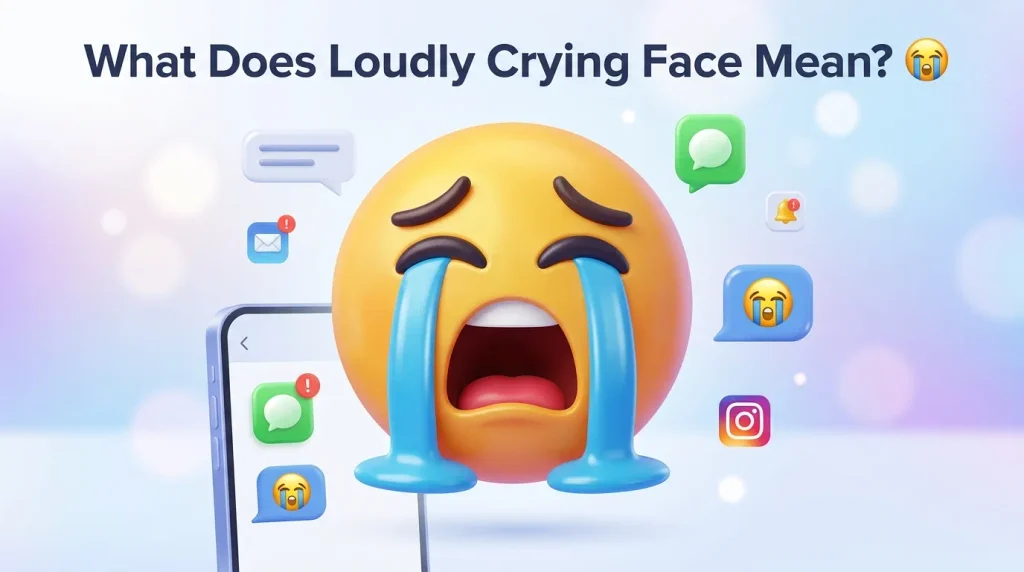
The loudly crying face 😭 generally represents intense crying, sadness, emotional pain, or being overwhelmed by feelings.
It shows a face with tears streaming heavily from both eyes. Compared with a simple sad emoji, it communicates a much stronger emotional reaction.
Common meanings include:
- Deep sadness
- Emotional overwhelm
- Missing someone
- Disappointment
- Happiness that feels overwhelming
- Laughing extremely hard
- Dramatic reactions
- Feeling touched or moved
For example:
“I can’t believe you remembered my birthday 😭”
Here, 😭 may express happiness and emotional gratitude rather than sadness.
Another example is:
“That ending broke my heart 😭”
In this context, the emoji clearly emphasizes sadness.
The surrounding words are important because the same emoji can communicate completely different emotions.
Different Meanings of Loudly Crying Face
The emoji meaning of 😭 changes significantly depending on the situation. Here are some of its most common interpretations.
General Meaning
The general meaning is intense emotion. It can represent crying, sadness, frustration, excitement, or emotional overwhelm.
It is often stronger than 😢 because the tears appear much more dramatic.
Romantic Meaning
In romantic conversations, 😭 can show that someone feels deeply emotional.
For example:
“I miss you so much 😭❤️”
This can communicate longing, affection, or emotional vulnerability.
It can also appear after receiving a sweet message:
“You are seriously the sweetest 😭❤️”
Friendly Meaning
Friends often use 😭 in exaggerated or playful ways.
For example:
“You actually remembered that story 😭”
Here, the emoji may show amusement, surprise, or affection rather than genuine crying.
Funny Meaning
One of the most common modern uses of 😭 is laughing extremely hard.
For example:
“Why did he fall like that 😭😂”
The person is probably not sad. They are reacting strongly to something funny.
Sarcastic Meaning
The emoji can also make a statement intentionally dramatic.
“You didn’t text me back for five minutes 😭”
The speaker may be joking rather than genuinely upset.
Social Media Meaning
On social media, 😭 frequently appears in comments, memes, captions, and reactions.
People use it to express an intense response to:
- Funny videos
- Cute animals
- Celebrity moments
- Emotional stories
- Relatable memes
- Unexpected situations
Text Message Meaning
In texting, 😭 can mean anything from “I’m really sad” to “This is hilarious.”
The surrounding sentence usually provides the strongest clue.
Workplace Meaning
In professional conversations, it is best to use 😭 carefully.
Among close coworkers, it may be acceptable in casual chats:
“That meeting lasted two hours 😭”
But in formal emails, client communication, or serious workplace discussions, a crying emoji may appear too informal or emotionally exaggerated.
When Should You Use Loudly Crying Face?
Use 😭 when you want to communicate a strong emotional reaction.
Good situations include:
- Reacting to a very sad story
- Saying you miss someone
- Responding to an emotional movie
- Laughing at a hilarious message
- Reacting to a relatable meme
- Showing dramatic disappointment
- Reacting to something extremely cute
- Showing emotional happiness
Texting Examples
Sad:
“I can’t believe the movie ended like that 😭”
Funny:
“You really posted that picture 😭😂”
Romantic:
“I miss you already 😭❤️”
Cute:
“Look at this tiny puppy 😭🥹”
Dramatic:
“You ate the last slice without me 😭”
The key is context. If you use 😭 after a funny statement, people may interpret it as laughter rather than sadness.
What Does Loudly Crying Face Mean from a Girl?
When a girl sends 😭, it can have several meanings depending on the conversation.
She may genuinely be upset, emotionally touched, laughing hard, or simply reacting dramatically to something.
For example:
“You actually did that for me 😭”
This could indicate that she feels touched or appreciated.
On the other hand:
“That meme is killing me 😭”
usually suggests strong amusement.
If she sends 😭 after a romantic message, it may indicate that she feels emotional, touched, shy, or overwhelmed. However, the emoji alone cannot reliably establish romantic interest.
What Does Loudly Crying Face Mean from a Boy?
A boy using 😭 may also be expressing strong emotion, humor, frustration, or exaggeration.
For example:
“Bro, I studied all night and the test was nothing like the notes 😭”
This probably expresses frustration.
Meanwhile:
“That video was insane 😭😂”
likely indicates laughter.
In casual conversations, boys may use 😭 as a playful reaction without actually being sad. The exact text meaning depends on the words and situation around it.
Loudly Crying Face on Snapchat
On Snapchat, 😭 is commonly used in chats, captions, Stories, and replies.
Users may add it to a snap when something is:
- Hilarious
- Embarrassing
- Emotional
- Cute
- Frustrating
- Dramatic
For example:
“I forgot my homework again 😭”
A Snapchat message containing 😭 can make the tone feel more expressive and less serious.
Loudly Crying Face on WhatsApp
The loudly crying face is extremely useful among WhatsApp emojis because it works in both serious and casual conversations.
You might send:
“I really miss everyone 😭❤️”
or:
“You guys are too funny 😭😂”
In WhatsApp group chats, 😭 is often used as a quick reaction instead of writing a full sentence.
It can also appear with other emojis to clarify the intended emotion.
Loudly Crying Face on Instagram
On Instagram, 😭 is popular in comments, captions, Reels, Stories, and direct messages.
For example:
“This is too cute 😭”
or:
“I can’t stop watching this Reel 😭😂”
When used with Instagram emojis, it often creates an exaggerated emotional reaction that fits memes and short-form content.
Loudly Crying Face on TikTok
TikTok users frequently use 😭 in comments and captions.
A creator might post something funny, and viewers may respond:
“I wasn’t ready for that 😭”
or:
“Why is this literally me 😭”
Here, 😭 often means “This is so funny” or “This is painfully relatable.”
This is one reason the emoji appears frequently alongside popular TikTok emojis and meme-style language.
Emoji Combinations
Combining 😭 with another emoji can make the intended emotion clearer.
| Emoji Combination | Meaning |
|---|---|
| 😭😂 | Laughing extremely hard |
| 😭🤣 | Can’t stop laughing |
| 😭❤️ | Deeply emotional or affectionate |
| 😭🤦 | Touched or emotionally overwhelmed |
| 😭💔 | Heartbreak or deep sadness |
| 😭🙏 | Emotional plea or dramatic request |
| 😭✨ | Emotional excitement or happiness |
| 😭🤦 | Strong affection or appreciation |
| 😭😩 | Frustration or emotional exhaustion |
| 😭😢 | Intense sadness |
| 😭💀 | Something is unbelievably funny |
| 😭🤦 | Frustration or disbelief |
| 😭😭 | Extremely emotional or dramatic |
| 😭🥺 | Emotional, vulnerable, or pleading |
| 😭💕 | Emotional affection or love |
These emoji combinations should always be interpreted according to the surrounding message.
Copy and Paste Loudly Crying Face
Here are some quick copy and paste emoji options:
😭 Copy
😭😭 Copy
😭😂 Copy
😭❤️ Copy
😭🥹 Copy
😭💔 Copy
😭🙏 Copy
😭✨ Copy
😭🤦Copy
😭😂💀 Copy
😭❤️Copy
😭💔😢 Copy
Simply select the emoji combination you want and copy it into your message, caption, comment, or profile.
Similar Emojis
Several emojis can look or feel similar to 😭, but each has a slightly different emotional purpose.
| Emoji | Name | Meaning | Difference |
|---|---|---|---|
| 😢 | Crying Face | Sadness | More restrained crying |
| 😭 | Loudly Crying Face | Intense emotion | Stronger tears and emotion |
| 🤦 | Face Holding Back Tears | Emotional | Suggests trying not to cry |
| 😥 | Sad but Relieved Face | Sadness/relief | Has a more subtle expression |
| 😿 | Crying Cat | Sadness | Uses a cat face |
| 😞 | Disappointed Face | Disappointment | Less dramatic than 😭 |
| 😔 | Pensive Face | Thoughtful sadness | Quiet or reflective |
| 🥺 | Pleading Face | Begging/cuteness | Often softer and more vulnerable |
| 😂 | Face with Tears of Joy | Strong laughter | Tears come from laughing |
| 🤣 | Rolling on the Floor Laughing | Extreme laughter | Clearly focuses on humor |
| 💔 | Broken Heart | Heartbreak | Represents emotional pain without a face |
The biggest difference is that 😭 can represent both genuine crying and exaggerated reactions, depending on context.
Emoji Appearance Across Platforms
The exact design of 😭 can vary slightly between platforms.
Apple
Apple’s version has large tears streaming down the face with a strongly distressed expression.
Android
Google’s Android design also shows prominent tears, although facial details and proportions can differ.
Samsung
Samsung may use its own visual styling, changing details such as the eyes, mouth, and tear shape.
Windows
Windows displays its own emoji artwork, which can look slightly different from mobile versions.
Facebook’s emoji design may use different facial proportions and shading while keeping the same general meaning.
WhatsApp has its own emoji artwork. The visual appearance can therefore differ from the version you see on your phone’s operating system.
Despite these differences, the Unicode emoji itself remains the same character. This means someone can send 😭 from one platform and another person can receive the corresponding emoji on a different platform.
Fun Facts
Here are eight interesting facts about the loudly crying face:
- 😭 can represent laughter. In internet conversations, it often means something is extremely funny.
- It is stronger than 😢. The streaming tears create a more intense emotional impression.
- Context changes everything. “I miss you 😭” and “That joke 😭” communicate very different feelings.
- It works with many emotions. Sadness, happiness, frustration, laughter, and affection can all be expressed with it.
- It is popular in memes. Meme culture helped expand the emoji beyond its traditional crying meaning.
- It is common in comments. Short reactions such as “😭” can communicate a complete emotional response.
- It can be dramatic. People often use multiple crying emojis to exaggerate a reaction.
- Its appearance varies. Apple, Android, Samsung, Windows, Facebook, and WhatsApp may display the character differently.
Common Mistakes
One common mistake is assuming that 😭 always means genuine sadness.
For example, if someone comments “This is so funny 😭,” they probably mean they are laughing hard.
Another mistake is interpreting the emoji without reading the surrounding message. Emojis add emotional information, but the words around them usually provide the necessary context.
People also sometimes confuse 😭 with 😂 or 🤣. While all three can appear after something funny, 😭 is more flexible and can represent many types of intense emotion.
Using 😭 in a serious professional conversation can also create confusion. In formal communication, clear words are usually safer than relying on an emoji.
Finally, sending several 😭 emojis does not necessarily mean someone is genuinely crying. Online communication often uses exaggeration for humor.
FAQs:
What does the loudly crying face 😭 mean?
The loudly crying face 😭 usually represents intense sadness, crying, emotional overwhelm, or distress. However, online conversations often use it to express extreme laughter, excitement, affection, or dramatic reactions. The exact meaning depends on the message, relationship, platform, and other emojis surrounding it.
Does 😭 mean laughing?
Yes. In casual online communication, 😭 can mean something is extremely funny. People often use it after memes, jokes, videos, or embarrassing situations. For example, “You actually said that 😭” may mean “That is so funny.” Adding 😂 or 🤣 can make the humorous interpretation even clearer.
What does 😭 mean from a girl?
A girl using 😭 may be genuinely sad, emotionally touched, laughing hard, frustrated, or joking dramatically. The emoji alone does not provide enough information to determine exactly what she feels. Look at the surrounding message, conversation topic, and other emojis before interpreting her response.
What does 😭 mean from a boy?
A boy may use 😭 to express sadness, frustration, laughter, embarrassment, or an exaggerated reaction. In casual texting, it is frequently used as a humorous response. For example, “Bro, that’s chaotic😭” may communicate surprise or amusement rather than actual crying.
What does 😭 mean in texting?
In texting, 😭 generally communicates an intense emotional reaction. Depending on context, it can mean “I’m crying,” “I’m so sad,” “that’s hilarious,” “I’m overwhelmed,” or “I can’t believe this.” Reading the complete message is important because the emoji has several common interpretations.
What does 😭❤️ mean?
😭❤️ usually combines strong emotion with affection or love. It can mean someone feels deeply touched, misses someone, appreciates them, or is emotionally overwhelmed by something sweet. However, it does not automatically indicate romantic feelings because friends and family can use the same combination.
What is the difference between 😭 and 😢?
😢 usually expresses ordinary sadness or disappointment, while 😭 represents a much stronger emotional reaction. The loudly crying face has prominent streams of tears and can also be used humorously. In internet culture, 😭 is often more dramatic and versatile than 😢.
Is 😭 a good emoji for social media?
Yes, 😭 is widely used on social media for emotional reactions, humor, memes, cute content, disappointment, and dramatic responses. It works especially well in short comments and captions. Still, its meaning depends on context, so pairing it with another emoji can make your intended emotion clearer.
Conclusion:
The loudly crying face 😭 is much more flexible than its name suggests. It can express deep sadness, emotional happiness, laughter, frustration, affection, embarrassment, or an exaggerated reaction.
Its meaning depends heavily on context, so always consider the words around it and the relationship with the person using it. Whether you’re replying on WhatsApp, commenting on Instagram, reacting on Snapchat, or watching TikTok content, 😭 can add a strong emotional touch.
Use it naturally, combine it with other emojis when helpful, and remember that not every 😭 means someone is literally crying.

I am Emily Carter, an emoji enthusiast and writer at Emojipedias.com. I love exploring emoji meanings, trends, and creative ways to make digital conversations more expressive.